
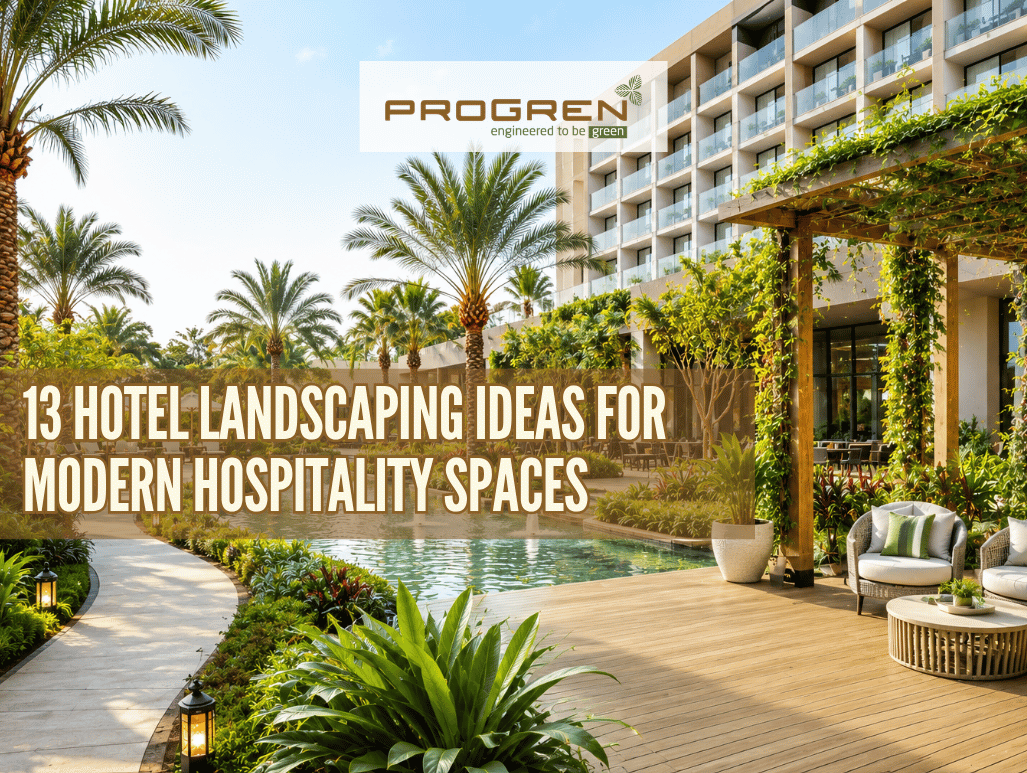
13 Hotel Landscaping Ideas for Modern Hospitality Spaces
Your hotel gets guests every day. But how many of them actually spend time outside?
If your pool deck sits half-empty by 2 p.m., your garden path is just something people walk through on the way to their room, and your rooftop looks better in photos than it does in person, the problem may not be your landscaping budget. It may be your landscaping design.
We've seen this happen with properties that spend heavily on planting, lighting, and hardscaping, yet still end up with outdoor spaces guests barely use.
The reason is usually simple: the spaces look fine, but they don't give anyone a reason to stay.
Maybe there's no shade where it's actually needed. Maybe the layout doesn't tell guests where to go. Maybe the pool deck is one big open slab instead of anywhere someone would want to sit down.
At Progren Flooring, we look beyond how a landscape photographs. We look at what happens once guests actually step outside, and where the design starts losing them.
Here are thirteen ideas worth building into a hotel landscape — and what tends to go wrong when they're missing.
The Real Problem Isn't Always More Landscaping
Adding more planting sounds like the obvious fix when an outdoor space isn't getting used.
But imagine a resort with a huge, lush garden that nobody actually walks through, because there's nowhere to sit, no shade, and no reason to linger. More greenery wouldn't fix that. Better design would.
The same thing plays out across most hotel properties.
A landscape needs to do more than look good from the lobby window. It needs to give guests somewhere comfortable to be, guide them naturally around the site, and make outdoor time feel like part of the stay rather than something to rush through.
Before spending more on planting or hardscaping, it's worth asking: are guests actually using the outdoor spaces you already have?
Do they linger, or pass through quickly?
Does the landscape feel like it belongs to the property, or like it was added afterward? Is there a reason to be outside after dark? And does every area have an obvious purpose?
If the honest answer to several of these is no, the fix usually isn't more landscaping — it's better-designed landscaping.
1. Give the Entrance a Strong First Impression
Of every outdoor area on a property, the entrance carries the most weight.
Guests should sense a hotel's personality the second they arrive. A luxury property might lean on structured planting, statement lighting, oversized planters, and crisp, deliberate pathways. A resort usually works better going looser — tropical greenery, natural textures, less symmetry.
What does the entrance look like from the road? Is the path to the door obvious, or does someone have to guess? Does the landscaping feel connected to the building, or bolted on beside it? Does it hold up after dark, once the daylight softness disappears? Are people on foot kept clearly separate from cars and drop-offs?
Our Tip Don't try to fill every open patch of ground with something green. A handful of well-placed statement features almost always lands harder than a garden crammed with plants competing for attention.
2. Let Landscaping Do Some of the Wayfinding
Landscaping can quietly steer guests toward where they're going, without a single arrow or sign.
Think about a large resort. Guests need to find the restaurant, the pool, the spa, their villa, maybe an event lawn or the parking area — and if every stretch of the property looks the same, the whole place starts to feel like a maze. Pathways, planting, lighting, and changes in decking or surface texture can all act as a visual cue, guiding people almost without them noticing.
On bigger projects, it helps to bring in experienced Landscape Contractors in Dubai early like us, while the plan is still taking shape, rather than once the layout is already locked in.
Our Tip: Don't treat a pathway as a pure A-to-B route. Add greenery, a bench, some lighting, or a small feature along the longer stretches, and walking across the property starts to feel like part of the stay rather than just a way to get somewhere else.
3. Make the Pool Area Somewhere Guests Actually Want to Stay
For a lot of hotels and resorts, the pool is the headline act. But the pool itself is really only half the picture.
What surrounds it matters just as much — shade, comfortable seating, greenery, lighting, somewhere to eat, and flooring that suits the environment. Get all of that right, and even an ordinary pool can become the place guests spend most of their afternoon.
Instead of one big open deck, more hotels are breaking the pool area into smaller, purpose-built zones — a lounging pocket here, a dining spot there, a quieter corner somewhere else. It sounds like a small change. It makes the whole space feel far more intentional.
It's worth coordinating early with our Swimming Pool Companies team in Dubai, so the pool and everything around it get designed as one connected environment instead of two separate projects sitting next to each other.
Our Tip: Plan shade before you plan furniture. In hot climates especially, shade — not extra seating — decides whether a pool deck is actually usable through the middle of the day. Pergolas, sail shades, and mature canopy trees do more for guest comfort between roughly 11 a.m. and 4 p.m. than anything else you could add.
4. Bring Decking Into the Landscape Design Early
Outdoor flooring can genuinely change how a hotel landscape reads.
A deck can anchor a seating area, tie a restaurant into the garden behind it, define a poolside lounge, or take the edge off a rooftop terrace that would otherwise feel cold and exposed.
Flooring should be considered during the landscape planning stage, not added afterward as a finishing touch — because it actually shapes the layout. The size and direction of decking boards can influence where furniture ends up, how people move through a space, where planting makes sense, and even how big or small an area feels.
For hospitality projects looking for a contemporary alternative to timber, composite decking Dubai is worth a look for the right applications.
Our Tip: Match the flooring to where it's actually going to live. A quiet garden seating nook has very different demands from the deck wrapped around a busy hotel restaurant or pool.
5. Make Outdoor Dining Feel Like a Destination
Outdoor dining has moved well past a handful of tables pushed outside the restaurant door.
Greenery, warm textures, comfortable furniture, soft lighting, and flooring that's clearly zoned for the purpose now work together so guests actually want to stay, rather than just pass through on their way inside. Planters help too, creating a sense of separation between areas without walling anything off.
Biophilic design has become a genuine force in hospitality rather than a buzzword. Instead of treating plants as decoration, the idea is to weave nature through the whole dining experience — greenery, natural-feeling materials, daylight, water, open views — so an outdoor restaurant feels connected to its surroundings, not just placed next to a garden.
Our Tip: Think about stretching the usable season. Retractable canopies, louvred pergolas, and discreet outdoor heating keep terraces and garden dining spaces in play outside of peak weather, instead of sitting empty half the year.
6. Add an Outdoor Kitchen or Entertaining Zone
Outdoor kitchens have come a long way from a single built-in barbecue tucked against a wall.
Newer hospitality projects treat them as proper destination zones — a counter or island with real storage, a cooking surface that guests can actually watch, and enough nearby seating to hold a small crowd. The goal is usually to keep guests on the property into the evening rather than sending them off-site for dinner.
A few things separate the ones that work from the ones that don't: lighting layered well enough that the space still functions after sunset, weatherproof storage designed in from the start, a flooring surface tough enough to handle grease, heat, spills, and heavy equipment, and proximity to seating and shade so the kitchen reads as part of a bigger social space rather than sitting off on its own.
Our Tip: Pair the kitchen with a fire feature, a small bar, or lounge seating. That's usually what turns it from a cooking station into a genuine gathering spot.
7. Don't Write Off the Rooftop
A hotel rooftop doesn't have to stay an empty slab of concrete with a few plastic chairs on it.
With the right planning, it can become a restaurant, a lounge, a garden, an event space, or somewhere quiet to unwind above the noise of the street. Breaking a large rooftop into smaller zones tends to work better than treating it as one open field — dining in one section, lounge seating in another, greenery and shade tucked somewhere quieter.
That said, rooftops come with their own set of headaches. Weight limits, drainage, wind, sun exposure, irrigation, and maintenance access all need to be worked out before a single plant goes in.
Our Tip: Resist the urge to turn the whole roof into a garden. A few pockets of strategically placed greenery soften the space plenty, without creating a maintenance job nobody signed up for.
Shade & Comfort Checklist
Before finalising a pool deck, terrace, or rooftop layout, it's worth checking the basics.
|
Outdoor Element |
What to Check |
|
Shade coverage |
Is there shelter available between 11 a.m. and 4 p.m.? |
|
Seating placement |
Does seating follow the shade, not just the view? |
|
Surface heat |
Will the flooring stay comfortable barefoot in direct sun? |
|
Wind exposure |
Especially relevant for rooftops — has it been tested at height? |
|
Evening usability |
Does the space still work once the sun goes down? |
8. Turn Walkways Into Something Worth Walking
A walkway gets used again and again, so there's no real reason it has to stay purely functional.
Trees offer shade, planting creates a sense of privacy, lighting makes evening walks feel comfortable rather than sketchy, and a shift in flooring can quietly signal that you've moved from one zone into another.
Small seating points along longer paths help too — a bench under a tree, somewhere to pause for a minute. On their own, these details are minor. Together, they change how a whole walk through the property feels.
9. Pair Greenery With Modern Materials
One trend running through commercial hotel landscaping right now is the mixing of natural greenery with contemporary outdoor materials, rather than choosing one direction and sticking to it.
A combination that tends to hold up well: green plants, timber-look decking, stone, warm lighting, clean architectural lines. The greenery softens the harder surfaces, while the materials keep the whole thing feeling current rather than rustic or dated.
Our Tip: Stick to a consistent colour palette. You don't need identical materials in every corner of the property, but complementary colours and textures make the whole place feel like it was designed together, not assembled piecemeal.
10. Choose Climate-Smart, Water-Wise Planting
This one gets less attention than it should, especially in hot, dry climates like the UAE.
Planting that fights the local climate ends up costing twice — once to keep it alive through the summer, and again when it inevitably has to be replaced. Native and drought-adapted species are the smarter long-term bet, since they've already evolved deep root systems and other traits built for coping with heat and limited water.
Around the Gulf specifically, species like the ghaf tree, bougainvillea, desert rose, and various palms show up constantly, and for good reason — they hold up in extreme heat on a fraction of the irrigation that imported tropical planting needs.
Our Tip: Group plants by water need, use drip irrigation instead of sprinklers, water early morning or late evening rather than in the heat of the day, mulch exposed soil to hold onto moisture, and amend sandy or saline soil before planting rather than fighting it for years afterward. None of this has to look sparse — done properly, a climate-appropriate palette still reads as lush.
11. Build In Small Spaces for Privacy and Quiet Wellness
Not every guest wants a big open lawn or a busy terrace. Some just want a corner to themselves.
A small garden seat, a shaded bench, a private terrace, or a tucked-away courtyard gives people somewhere to slow down, and it doesn't need a huge footprint to work. Often it's just a comfortable seat, a bit of shade, a few well-chosen plants, soft lighting, and flooring that feels good underfoot.
Wellness itself has changed shape too. It's less about a scheduled spa slot now and more about spaces that invite a spontaneous pause — an open lawn suited to a bit of morning stretching, a shaded nook for reading, a quiet path that loops back around without asking the guest to make a decision.
Our Tip: Check the unused corners of the property before assuming you need more space to work with. Sometimes the opportunity's already sitting there, just overlooked.
12. Design for Day and Night Equally
A hotel landscape doesn't clock out when the sun goes down. Guests are still walking to dinner, sitting by the pool, eating outdoors, heading to an evening event — which makes lighting a genuine design element rather than something tacked on at the end.
Different areas call for different treatment: pathway lighting for visibility, accent lighting to pick out a tree or an architectural feature, softer lighting to set the mood around seating and dining.
Our Tip: Don't light everything the same. A landscape with layers of light almost always feels more considered than one where every corner is lit up at the same brightness.
13. Design for the Setting, Not Just Around It
The properties getting attention right now aren't the ones that added a patio and called it an outdoor space. They're the ones built with the surrounding landscape as a starting point, not a backdrop.
That might mean orienting a garden path toward an actual view instead of a blank wall, choosing plant palettes and materials that reflect what actually grows locally rather than a generic "resort" look, or simply making it easy for guests to get out and use the land the hotel sits on.
It's a bigger lift for a ground-up development, but even an existing property can lean into this — fewer imported design cues, more materials and planting that genuinely belong to the site.
The Guest Journey Through Your Outdoor Space
Most guests don't decide to "use the landscaping." They move through it in stages, the same way they move through a decision to book a return stay.
Arrival → they form a first impression at the entrance and along the path to reception. Exploration → they check out the pool, the gardens, the terraces, working out where they'll actually want to spend time. Comfort → shade, seating, lighting, and flooring either invite them to stay or send them back inside. Return → a landscape that worked well is part of why guests come back, or recommend the property to someone else.
If a design jumps straight from "here's the pool" to "hope you enjoy it," without giving guests a reason to actually stay outside, you lose people along the way.
Outdoor Space Audit Checklist
Before spending more on planting or hardscaping, take a few minutes to check the landscape you already have.
|
Landscape Factor |
Question to Ask |
|
Shade |
Is there real shelter during peak sun hours? |
|
Flooring |
Does it suit the traffic, moisture, and heat of the area? |
|
Wayfinding |
Can a first-time guest find their way without signage? |
|
Lighting |
Does the space still work well after dark? |
|
Maintenance |
Can the current team realistically keep it looking good? |
|
Climate fit |
Is the planting suited to the local conditions? |
|
Purpose |
Does every zone have an obvious reason to exist? |
If several answers come back "no," you may have found some of the reasons guests aren't spending as much time outside as you'd like.
What to Improve First
A full landscape overhaul isn't always necessary. Often a handful of focused changes make a bigger difference than starting from scratch.
Start with these: add shade where guests actually sit, break up large open decks into smaller purpose-built zones, swap thirsty imported planting for climate-appropriate species, fix the flooring in high-traffic areas before it becomes a liability, layer the lighting instead of lighting everything equally, add a few small private corners in unused space, and make sure pathways actually guide people rather than just connecting two points.
The goal isn't to change everything at once. Find where guests are losing interest in the outdoor space, and fix that first.
Landscaping Trends Hotels Should Watch in 2026
Climate-Smart Planting: Native and drought-adapted species are moving from a sustainability talking point to a default choice, simply because they cost less to maintain and hold up better under real heat.
Outdoor Kitchens and All-Season Terraces: Retractable canopies, outdoor heating, and destination-style cooking zones are helping hotels keep outdoor spaces generating revenue across more of the day and more of the year.
Embedded, Unscheduled Wellness: Wellness is spreading out of the spa and into the wider landscape — quiet corners, shaded reading nooks, and open lawns that invite a pause without needing a booking.
Site-Specific, Not Generic, Design: Properties are moving away from an imported "resort" look toward landscapes that reflect the actual place they're built on — local materials, local planting, real views.
Data-Informed Maintenance: More hotels are tracking which outdoor spaces guests actually use, rather than assuming a landscape is working simply because it looked good on opening day.
How Progren Flooring Helps Hospitality Projects
We don't believe every project needs a full redesign. Sometimes the bones of a landscape are fine, and the real issue is the flooring, the shade, or the layout of one specific zone.
|
Our Approach |
What It Does |
|
Site and usage assessment |
Identifies where guests are and aren't spending time |
|
Flooring selection by zone |
Matches material to traffic, moisture, heat, and use |
|
Shade and comfort planning |
Makes outdoor spaces usable through peak hours |
|
Climate-appropriate planting guidance |
Reduces long-term water and maintenance costs |
|
Coordination with contractors and pool specialists |
Keeps the landscape designed as one connected space |
|
Maintenance-minded design |
Builds in access and durability from day one |
We don't want to recommend changes simply because they look good in a render. We want to understand why guests aren't using a space, and what would actually change that.
Is Your Landscape Helping or Holding Your Property Back?
Ask yourself: do guests actually spend time in your outdoor spaces, or just pass through them? Does the entrance build a strong first impression within the first few seconds? Is there shade where people actually need it? Does the property look and function well after dark? Can maintenance realistically keep up with what's been planted? Does every outdoor zone have a clear purpose? And do you know which parts of the landscape guests actually use, or are you guessing?
If several answers come back "no," your landscape may be limiting the guest experience without you realising it. More planting isn't always the answer. Sometimes the better opportunity is getting more out of the outdoor space you already have.
Frequently Asked Questions
What are the most important areas to landscape in a hotel? The entrance, pool area, outdoor dining spaces, pathways, gardens, and terraces tend to matter most, since they carry the heaviest guest traffic and the strongest first impressions.
What are the latest trends in hotel landscaping? Climate-appropriate planting, multi-use outdoor spaces, outdoor kitchens and all-season terraces, layered lighting, quiet wellness corners, and landscaping designed around the actual site rather than a generic resort look.
What type of flooring works for hotel outdoor spaces? It depends on where it's going and how it's used. Poolside areas, restaurants, walkways, rooftops, and gardens all come with different demands around traffic, moisture, sunlight, and maintenance.
How can hotels make small outdoor areas more attractive? You don't need a large footprint. Thoughtful planting, comfortable seating, the right flooring, some shade, and good lighting can turn a forgotten corner into a space guests actually use.
How important is lighting in hotel landscaping? Very. Hotels run around the clock, so lighting needs to handle visibility and mood at once. Layered lighting almost always beats lighting everything equally bright.
How can hotel landscaping reduce maintenance requirements? Start with plants suited to the local climate, use drip irrigation and mulch, keep the design from getting unnecessarily complicated, and make sure maintenance teams can actually reach every area.
Should outdoor flooring be chosen before landscaping begins? Ideally, they're planned together. Flooring affects pathways, seating, and planting zones, so working on both at once produces a more cohesive result.
Is native or drought-tolerant planting suitable for a luxury hotel, or does it read as budget? Not if it's done well. Bougainvillea, desert rose, and mature palms show up across high-end resort landscaping precisely because they look lush while needing far less water and maintenance than imported tropical planting.
Final Thoughts
A hotel landscape doesn't need to be enormous to be a genuine business asset.
It needs to give guests a reason to actually use it.
When someone steps outside, they should quickly sense where to go, find somewhere comfortable to stay, and feel like the space was designed with them in mind. If any part of that experience creates friction — no shade, confusing paths, a deck that's too hot to sit on — guests will simply go back inside, even if they were genuinely interested in spending time outdoors.
At Progren Flooring, we look at more than how a landscape photographs. We look at how guests actually move through it, and where the design is losing them.
Whether the problem is missing shade, the wrong flooring, unclear wayfinding, thirsty planting, or maintenance nobody planned for, the right improvements can help you get far more value from the outdoor space you already have.
A hotel landscape shouldn't just look good from the lobby window. It should give guests a reason to stay, relax, and remember the property.
If your outdoor spaces are getting less use than they should, it may be time to look past how they photograph and start looking at how they actually work.